
Why Every Business Needs a Clear Employee Onboarding Policy
Introduction
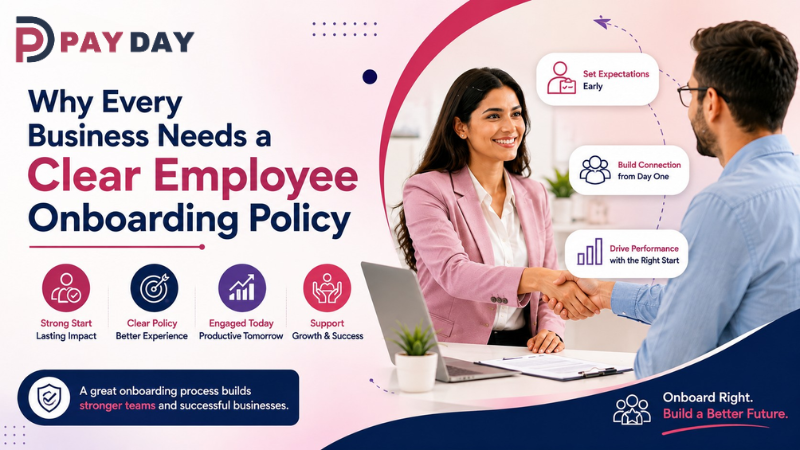
Hiring the right employee is only the first step toward building a successful workforce. The real journey begins when a new hire joins your organization. Without a structured onboarding process, employees may struggle to understand company expectations, workplace policies, and their responsibilities. This can lead to confusion, lower productivity, and higher employee turnover.
An Employee Onboarding Policy provides a clear framework for welcoming new employees, completing documentation, assigning responsibilities, introducing company policies, and preparing them for long-term success.
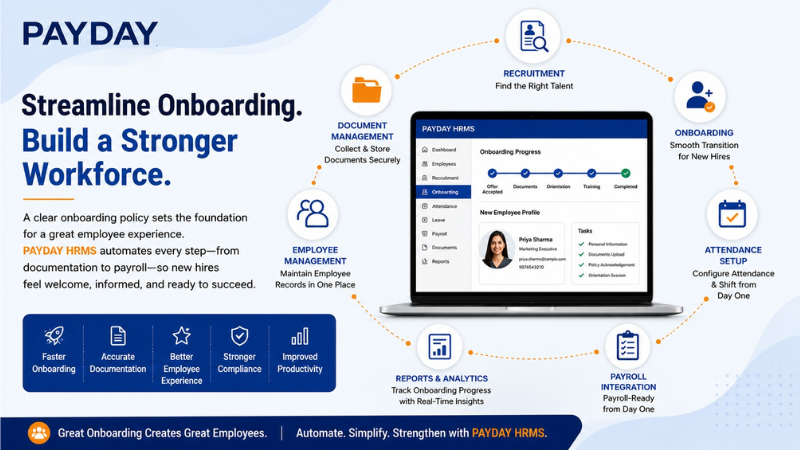
With PAYDAY HRMS, businesses can automate onboarding while connecting it with recruitment, employee management, attendance, payroll, letter management, and HR reports—creating a seamless employee experience from day one.
What Is an Employee Onboarding Policy?
An Employee Onboarding Policy is a documented process that outlines how new employees are introduced to the organization. It defines the steps HR managers, department heads, and employees should follow from the day an offer is accepted until the employee becomes fully integrated into the company.
A well-defined policy helps ensure consistency, compliance, and a positive experience for every new hire.
Why Is an Employee Onboarding Policy Important?
A structured onboarding policy helps businesses:
- Create a positive first impression
- Reduce administrative delays
- Ensure policy compliance
- Improve employee engagement
- Increase productivity
- Standardize onboarding across departments
It also helps HR teams deliver a consistent onboarding experience regardless of team size or office location.
1. Standardize the Hiring-to-Joining Process
Without a clear onboarding policy, every manager may follow a different process. This inconsistency can result in missed documents, delayed system access, or incomplete orientation.
How PAYDAY HRMS Helps
The Recruitment Management and Onboarding modules work together to create a smooth transition from candidate selection to employee onboarding. HR teams can track each stage, assign onboarding tasks, and ensure every requirement is completed before the employee's first day.
2. Simplify Employee Documentation
Collecting and organizing employee documents manually can be time-consuming and prone to errors.
How PAYDAY HRMS Helps
HR teams can securely collect and manage:
- Identity proof
- Educational certificates
- Employment contracts
- Tax documents
- Bank details
The Employee Management module stores all records in one centralized location for easy access and future reference.
3. Communicate Company Policies Clearly
Every new employee should understand the organization's policies from the beginning.
A good onboarding policy includes:
- Working hours
- Attendance rules
- Leave policy
- Code of conduct
- IT usage guidelines
- Workplace safety
Providing this information early reduces misunderstandings and promotes a positive work culture.
4. Connect Onboarding with Attendance
Employees should be able to start marking attendance from their first working day without delays.
How PAYDAY HRMS Helps
The Attendance Management module enables businesses to configure attendance rules, shifts, and employee profiles during onboarding. Whether your organization uses biometric devices, web check-ins, or GIS-based attendance, new employees can be integrated into the attendance system quickly.
5. Ensure Payroll Readiness
Payroll delays often occur when employee information is incomplete or inaccurate.
How PAYDAY HRMS Helps
During onboarding, HR can collect salary details, tax information, bank account details, and compensation structures. This information flows directly into the Payroll Management module, helping ensure accurate salary processing from the first payroll cycle.
6. Automate HR Documentation
Generating appointment letters, joining letters, and other documents manually can slow down the onboarding process.
How PAYDAY HRMS Helps
The Letter Management module allows HR teams to generate and manage:
- Offer Letters
- Appointment Letters
- Confirmation Letters
- Policy Acknowledgements
This reduces paperwork and ensures consistency across the organization.
7. Monitor Progress with Reports
A structured onboarding process should be measurable.
How PAYDAY HRMS Helps
Managers can track:
- Pending onboarding tasks
- Document completion
- New employee status
- Department-wise onboarding reports
Real-time dashboards help HR teams identify delays and improve onboarding efficiency.
Benefits of a Clear Employee Onboarding Policy
A well-defined onboarding policy helps organizations:
- Improve the new employee experience
- Reduce administrative workload
- Standardize HR processes
- Ensure compliance with company policies
- Accelerate employee productivity
- Improve communication between HR and managers
- Minimize onboarding delays
- Strengthen employee retention
Why Choose PAYDAY HRMS?
PAYDAY HRMS simplifies every stage of the employee journey through integrated modules:
- Recruitment Management
- Employee Onboarding
- Employee Management
- Attendance Management
- Leave Management
- Payroll Management
- Letter Management
- GIS Attendance
- Reports & Analytics
- Multi-location Workforce Management
By connecting these modules, businesses can provide a smooth onboarding experience while improving operational efficiency and reducing manual work.
Frequently Asked Questions
1. What is an Employee Onboarding Policy?
An Employee Onboarding Policy outlines the steps, responsibilities, and procedures for integrating new employees into an organization.
2. Why is an onboarding policy important?
It helps standardize onboarding, improve employee engagement, ensure compliance, and reduce administrative errors.
3. Can onboarding software improve employee productivity?
Yes. By automating documentation, task assignments, and policy communication, onboarding software helps employees become productive more quickly.
4. How does PAYDAY HRMS support onboarding?
PAYDAY HRMS integrates recruitment, onboarding, employee management, attendance, payroll, letter management, and reporting into one platform.
5. Is PAYDAY HRMS suitable for growing businesses?
Yes. PAYDAY HRMS is designed for businesses of all sizes and supports scalable HR operations across multiple locations.
Conclusion
A clear Employee Onboarding Policy is more than a checklist—it is the foundation for a positive employee experience and efficient HR operations. By standardizing onboarding, businesses can improve compliance, reduce administrative work, and help new employees become productive faster.
With PAYDAY HRMS, organizations can automate onboarding while seamlessly connecting it with recruitment, employee management, attendance, payroll, HR documentation, and reporting. This integrated approach creates a consistent, professional onboarding experience that supports long-term business growth.